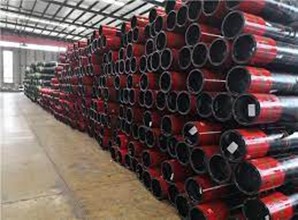
Casing Pipe Sizes and Classifications
Casing pipes are classified based on their outer diameter (OD), wall thickness, and end finish. API 5CT specifies various casing sizes, weights, and grades according to different well conditions. Below are the most common casing sizes:
| Nominal Size (inches) |
Outer Diameter (mm) |
Weight Range (lb/ft) |
Wall Thickness (mm) |
| 4 1/2” |
114.3 |
9.5 – 15.1 |
5.21 – 7.37 |
| 5 1/2” |
139.7 |
14 – 23 |
5.59 – 9.17 |
| 7” |
177.8 |
23 – 35 |
7.52 – 10.92 |
| 9 5/8” |
244.5 |
32.3 – 53.5 |
8.94 – 13.72 |
| 13 3/8” |
339.7 |
48 – 72 |
9.65 – 16.13 |
| 16” |
406.4 |
65 – 97 |
9.52 – 19.06 |
| 20” |
508 |
94 – 133 |
11.13 – 16.13 |
Grades of Casing Pipes
H40, J55, K55 Low to moderate strength for shallow wells.
N80, L80, C90, T95Medium to high strength with improved resistance to collapse and burst pressure.
P110, Q125 High-strength casing for deep and high-pressure wells.
Special Grades: Including proprietary grades with enhanced corrosion resistance, such as
Casing Connections
– API Buttress (BTC) – Standard connection with reliable sealing.
– Premium Connections – Enhanced metal-to-metal seals and torque capabilities for high-pressure wells.
– Semi-Premium Connections – Designed for improved mechanical performance compared to API standard connections.
– Threaded & Coupled (T&C) – Widely used for easy handling and installation.
Applications of Casing Pipes
– Conductor Casing – The first stage casing set to prevent well collapse and control surface-level pressure.
– Surface stage Casing – Protects freshwater aquifers and provides structural support.
– Intermediate Stage Casing – Isolates problem formations such as unstable zones or high-pressure zones.
– Production Stage Casing – Encloses the wellbore where production tubing is placed for hydrocarbon extraction.
– Liner Stage Casing – Used as an extension of the casing string to reinforce well integrity.